Web Application Development
Web applications, engineered to scale.
Portals, dashboards, booking systems and SaaS — built on Laravel 13 and Node.js, deployed with CI/CD, and handed over with documentation any developer can pick up.
Web Application Development in Jordan & the GCC
Short answer: Web application development is what you need when a website stops being enough — a customer portal, an internal system, a booking engine or a SaaS product. Consult One has built web applications in Amman since 2004, on Laravel 13 and Node.js, for clients across Jordan, the GCC and the United States. Most business web applications land between $8,000 and $40,000, fixed against a written specification before any code is written.
A brochure website tells people who you are. A web application does work for you: it takes bookings, tracks jobs, serves your customers at two in the morning and replaces the spreadsheet three people are currently emailing back and forth. This page explains how we approach web application development, which technologies we use and why, what it costs, and how to tell whether you actually need one.
What we build#
Almost every web application development project we take on falls into one of six shapes. Yours probably does too, and knowing which one you are in changes what web application development should cost you.
- Customer and partner portals — give clients their own login to see orders, documents, invoices and status without phoning your team.
- Admin dashboards and internal tools — the system your staff actually work in all day, replacing spreadsheets and disconnected apps.
- Booking and reservation systems — availability, payment, confirmation and reminders, handled end to end.
- SaaS products — multi-tenant applications with subscription billing, for businesses selling software rather than buying it.
- E-commerce beyond the template — custom checkout logic, B2B pricing tiers, ERP synchronisation and regional payment gateways.
- API back ends for mobile apps — the server half of an iOS or Android product, often built alongside the app itself.
How we choose the technology#
There is no single best stack for web application development, and any agency that tells you otherwise is describing the only thing they know. Good web application development starts with matching the tool to the problem. We pick per project, and we tell you why in writing.
Laravel 13 for business logic#
Laravel is the most widely used PHP framework in the world, and version 13 runs on PHP 8.3. It is our default for applications where the value sits in business rules — approvals, pricing, permissions, reporting. It is mature, secure by default, heavily documented, and any competent PHP developer can pick up the codebase after us. That last point protects your investment more than any technical benchmark. See our Laravel development page for detail.
Node.js for real time and scale#
When an application needs to do many things at once — live tracking, chat, notifications, dashboards that update themselves, APIs serving thousands of concurrent users — Node.js is the better engine. One language across the front and back end also means a leaner team and faster iteration. More on our Node.js development page.
WordPress when the answer is content#
Sometimes the honest answer to a web application development brief is that you do not need one. If the real requirement is publishing and editing content, a well-built WordPress site will serve you better and cost a fraction as much. We say so when it is true.
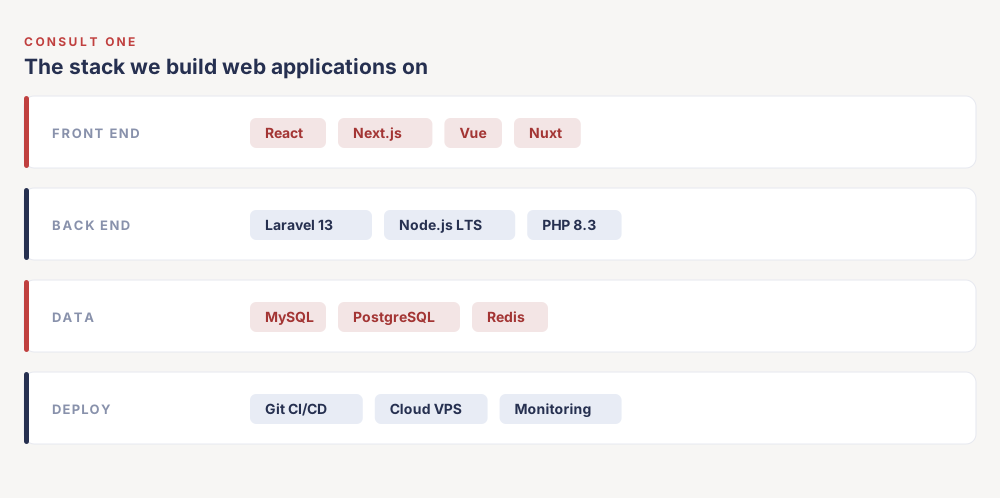
Our web application development process#
Most failed projects fail in the first two weeks, before anyone writes code, because nobody agreed what was being built. Our process front-loads that argument deliberately.
- Discovery, paid and fixed-scope. We map your workflow, interview the people who will use the system, and produce a written specification with screens, rules and edge cases. You own that document whether or not you build with us.
- Fixed price against the specification. Once the spec is agreed the number does not move, because the scope does not move.
- Milestone builds you can log into. You test working software every two to three weeks, not a slide deck.
- Security review and load testing before launch, not after an incident.
- Training, documentation and a support SLA — handed to your team, in Arabic and English.
Every application we build is bilingual-capable from day one. Arabic is not a translation layer bolted on at the end; right-to-left layout, Arabic typography and date and number formats are designed in from the first screen.
What web application development costs#
Honest ranges for web application development, from projects we have actually delivered across Jordan and the Gulf:
- $8,000 – $15,000 — a focused internal tool or portal: one user type, a few core screens, straightforward reporting.
- $15,000 – $40,000 — a multi-role business application: several user types, payments or integrations, real reporting, a mobile-ready interface.
- $40,000+ — a SaaS product or an enterprise system with complex permissions, multi-tenancy and third-party integrations.
What moves the number is scope and integrations, not the country you are in. A booking system that talks to your accounting software and a payment gateway costs more than the same system standing alone — every time, everywhere.
Web application development questions we are asked most#
How long does a web application take to build?
Discovery takes two to three weeks. A focused internal tool follows in six to ten weeks; a multi-role business application in three to five months. We deliver in milestones, so you are using parts of the system well before the final one.
Laravel or Node.js: which is right for my project?
Laravel wins for data-heavy business applications built quickly and maintained cheaply. Node.js wins for real-time features and high-concurrency workloads. Plenty of our builds use both: Laravel for the business logic, Node for the live layer. You get a recommendation with reasons, not a default.
Do you take over an existing application?
Regularly. We start with a code audit and a written assessment of what you have, then a stabilisation plan before any new features. Inheriting a codebase responsibly takes longer at the start and saves months later.
Who owns the code when the project ends?
You do, in full, with the repository, documentation and a handover session. No licensing traps, and no dependency on us to keep the system running.
Do you build web applications for clients outside Jordan?
Yes. We serve eight markets: Jordan, Saudi Arabia, the UAE, Kuwait, Qatar, Bahrain, Oman and the United States. Our team works in Arabic and English and overlaps with both Gulf and US business hours.
Every major web technology, one team#
We pick the platform that fits the job, not the one we happen to know. Explore our dedicated pages: WordPress · WooCommerce · Shopify · Magento / Adobe Commerce · Drupal · Joomla · Webflow · HubSpot CMS · Laravel · Node.js · React / Next.js · Vue / Nuxt · ASP.NET Core · Python / Django. Or see the full Web & Software overview.
Talk to the people who will build it#
Tell us what the system needs to do and we will tell you whether web application development is the right answer. You will speak to a developer, not a salesperson, and get an honest answer about whether a web application is the right investment at all. See our work or start a conversation.